
From Saewold to Weston
The High Sheriff in Bicester’s Story
2/16/20263 min read
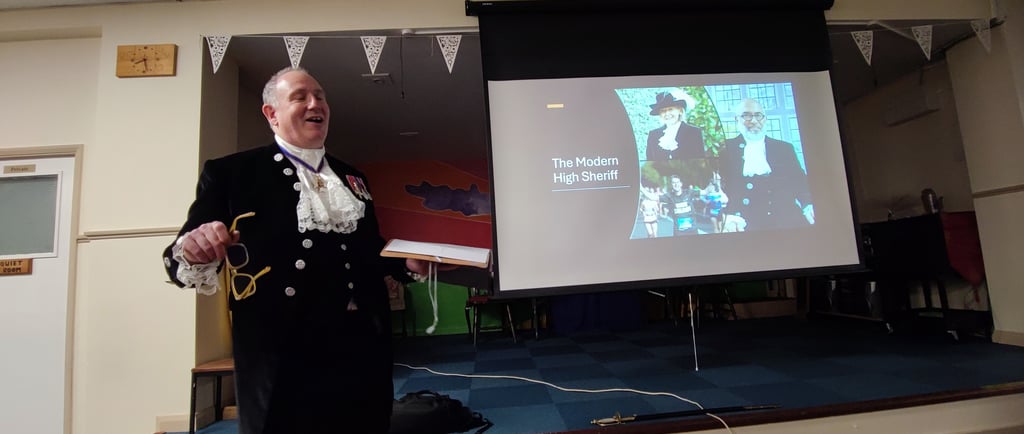
Tonight I had the pleasure of speaking to the Bicester Local History Society at the Clifton Centre, kindly invited by my good friend and fellow villager, Bob Hessian.
It was a wet February evening – the sort that would have given everyone a perfectly respectable excuse to stay at home – yet the room was full and attentive. There is something quietly heartening about that. Bicester takes its history seriously.
Speaking in Bicester about the history of the High Sheriff felt different from delivering the same material elsewhere. Much of what I was describing unfolded in and around this town. The story is not abstract. It is rooted in places we know – Weston on the Green, Tusmore, Stratton Audley, Stoke Lyne – names that still mean something locally.
I began before 1066.
One of the earliest recorded Sheriffs of Oxfordshire was an Anglo-Saxon official named Saewold, serving under Edward the Confessor in the 1060s. We know very little about him beyond his name in the record, but that entry is significant. It tells us that the office predates the Norman Conquest.
After 1066, Saewold disappears and a Norman takes his place. That man was Robert d’Oilly, a close associate of William the Conqueror and the builder of Oxford Castle. The Sheriff in that period was the King’s principal officer in the county: collecting revenues, presiding over the shire court, administering Crown lands and, when required, raising armed contingents.
If d’Oilly rode north into what we now call Bicester or Weston on the Green, he did so not ceremonially but as an agent of royal authority. The office at that stage carried real power.
From there we moved through the medieval centuries, including the role of the Ploughley Hundred, within which Weston lay. The Hundred was an administrative and judicial unit recorded in the Domesday Book of 1086. Governance operated in layers: village, Hundred, shire. The Sheriff presided at shire level but exercised authority through structures like the Hundred Court, which dealt with local disputes, taxation and the enforcement of frankpledge.
It is easy to imagine medieval administration as informal. In fact, it was structured and territorial. Weston and Bicester were not simply settlements in a loose county; they were part of a defined judicial district under shrieval authority.
We touched on Magna Carta, noting that twenty-seven of its clauses refer to sheriffs. That underlines how central the office had become to the exercise of royal power. If royal authority felt heavy-handed, it was often experienced through the Sheriff.
The Civil War provided another turning point. With Oxford as the Royalist capital, the Sheriff was caught up in allegiance and militia. In that period the office could carry significant coercive weight.
Until the nineteenth century, the Sheriff also remained responsible for carrying out capital sentences. That responsibility has long since passed, but it is part of the story.
As we moved into the twentieth century, the focus came closer to home.
Randal Smith, 2nd Baron Bicester of Tusmore Park, served as High Sheriff in 1945, at the end of the Second World War. It was a moment of national transition. Estates such as Tusmore were part of the rural economic and civic life of the county, and shrievalty at that time represented stability and continuity rather than enforcement. It was interesting to reflect, in a Bicester audience, on how the town and its surrounding estates were woven into the county’s constitutional life.
Earlier in the inter-war years, High Sheriffs from around Bicester – including Sir Algernon Peyton of Stoke Lyne and Major George Gosling of Stratton Audley – served during periods of economic strain and uncertainty. By then, the office was largely symbolic, but symbolism in unsettled times has its own importance.
Bringing the story into the present day, I spoke about the modern role of the High Sheriff as His Majesty’s Judicial Representative in the county. There is no executive authority now. I cannot direct police operations or influence court outcomes. Instead, the role involves supporting the Crown Court and judiciary, visiting prisons and probation services, recognising voluntary work in the justice system and encouraging early intervention.
My theme this year has been Hearing the Young Unheard. I mentioned meeting a young person in a custody suite who said that no one in authority had ever simply listened. It felt a telling contrast with the earlier history of the office.
Alongside the High Sheriff stands the Lord-Lieutenant, whose role has also evolved from military oversight in the sixteenth century to modern civic representation. Royal visits, honours and citizenship ceremonies now form part of the Crown’s presence in the county.
As I looked around the room last night, I was struck by how much of this history has unfolded within a few miles of where we were sitting. From medieval Hundred courts to Tusmore in 1945, and now to Weston on the Green in 2026, the office has changed profoundly in character. Its authority has softened, its powers reduced. But it has endured.
The questions at the end were thoughtful and informed – just what one would hope for from a Local History Society audience. It made for a stimulating and enjoyable evening.
My thanks to Bob for the invitation, and to everyone who turned out on a damp February night to explore a long strand of Oxfordshire’s history, much of it closer to home than we sometimes realise.
The Oxfordshire Shrievalty
Championing justice and community across Oxfordshire
© 2026. All rights reserved.