
Elgar’s The Kingdom in the Sheldonian
Oxford Bach Choir
3/15/20262 min read
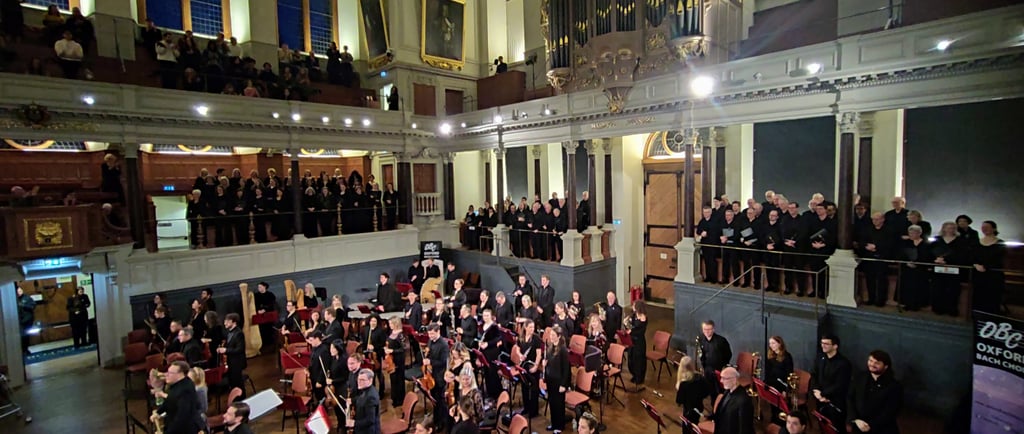
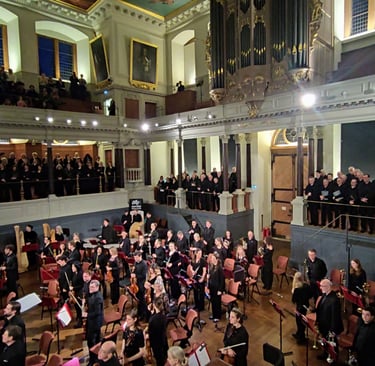
This evening, Mark and I had the pleasure of spending a couple of hours in one of Oxford’s most beautiful spaces, the Sheldonian Theatre, for a performance of Edward Elgar’s great oratorio The Kingdom by the Oxford Bach Choir.
We were seated in the Proctor’s Box, which offers a rather wonderful vantage point from which to take in both the music and the setting. The Sheldonian always feels special, but it feels particularly fitting for a work like this - grand, expansive, and full of drama.
The Kingdom was first performed in 1906 and forms the second part of Elgar’s great vision for a trilogy of oratorios exploring the story of the early Church. What makes tonight’s performance especially resonant in Oxford is that the work was first performed here by the Oxford Bach Choir in 1907, with Elgar himself conducting. It is rather lovely to think that more than a century later the same choir continues to bring the work to life in the same city.
This evening’s performance brought together the Oxford Bach Choir and the Bournemouth Symphony Orchestra under the direction of Benjamin Nicholas, alongside a quite exceptional quartet of soloists - Sophie Bevan, Catherine Wyn-Rogers, Benjamin Hulett and Gareth Brynmor John. The scale of the work is immense, but in the Sheldonian it never felt overwhelming; rather it unfolded with clarity, warmth and a wonderful sense of purpose.
The piece is monumental in scale. Written for full chorus, orchestra and four soloists, it moves from moments of powerful drama to passages of deep stillness and reflection. It tells the story of the early Christian community after the Resurrection, culminating in the great scene of Pentecost - music that builds with a sense of gathering energy and purpose.
The Oxford Bach Choir has been at the heart of the city’s musical life for well over a century, and tonight’s performance reminded us why. There is something special about hearing a large choral work performed in Oxford by singers who are part of that continuing tradition.
What struck me most this evening was the sense of continuity. The same choir. The same city. The same music. More than a hundred years after Elgar himself stood in front of them.
Traditions like this do not continue by accident. They endure because people care enough to keep them alive - singers, musicians, conductors and audiences alike.
It was a memorable evening of music in a remarkable setting - and a real pleasure to share it with Mark.
The Oxfordshire Shrievalty
Championing justice and community across Oxfordshire
© 2026. All rights reserved.